|
|
Radhika Bharat Ram is the Joint Vice Chairperson of The Shri Ram Schools. She is known for her commitment to progressive education and holistic learning. She works actively to strengthen educational ecosystems that nurture curiosity, compassion, and lifelong learning in young minds. Mrs Bharat Ram is also a passionate advocate for inclusive growth and women’s empowerment. On the occasion of National Education Day, she writes about the pressing need to see teachers as pivotal to our education system and build their capacity to shape future-ready citizens.
|
|
|
Reimagining Teacher Training and Partnerships for Future-Ready Citizens
|
The classrooms of tomorrow are being shaped today — not through bricks and benches, but through ideas, empathy, and imagination. As AI redefines work, sustainability redefines progress, and coexistence mandates global citizenship, formal education must change, with our teachers standing at its heart.
Our National Education Policy (NEP) 2020 advocates a robust and relevant system for a dynamic world, the responsibility of its delivery resting on our teachers. This makes it vital to continually strengthen teachers’ capabilities in line with the vision of an equitable, inclusive, and high-quality education system. There is therefore a pressing need to build teachers’ capacity, connecting them with the broader ecosystem of institutions that shape education and thought.
As an educationist, I recommend the following to reach this shared goal:
Dignity of the Teaching Profession
It is imperative that as a social commitment, the profession be celebrated and given the dignity it deserves, guiding and inspiring our teachers’ development.
To enable an academic environment that fosters fresh ideas, creativity, and innovation, teachers should be encouraged to share insights and influence decisions that shape their classrooms. Recognised as the architects and leaders of the education system and not merely its implementers, teachers must be trusted and valued so they develop a deeper sense of ownership.
Lifelong learning
A 2021 UNESCO report states that only 10 percent of teachers in India have access to continuous professional development. Given that there are a possible 97 lakh teachers, there is a significant opportunity to strengthen and modernise this need, aligned with the pace of change. Teacher training must therefore be continuous allowing them the space to learn constantly, lead with confidence, and adapt with agility. I have noticed that practice workshops, collaborative lesson planning, cross-disciplinary projects, co-created learning modules and shared experiences are particularly powerful in enhancing professional growth.
Such collaborations build confidence and nurture innovation and a shared sense of purpose.
Partnerships
The transformation we seek thrives on collaboration and shared purpose, as a collective endeavour to build a dynamic and symbiotic learning ecosystem to establish new pathways for knowledge exchange and universal growth.
For instance, when teacher training colleges collaborate with schools, teachers gain access to cutting-edge pedagogical research, while researchers benefit from authentic classroom insights. Engagements with both the corporate sector and non-profit sector — through CSR initiatives or volunteering — can bring valuable exposure to real-world problem-solving, innovation, and workplace skills that students increasingly need, along with much-needed empathy and a humane approach.
I know that a teacher who feels supported — both emotionally and intellectually — is far more likely to inspire students leading to a positive shift in mindset, which will truly mark the beginning of true and lasting transformation.
Strengthening Industry-Academia Linkages
The Confederation of Indian Industry (CII), through its Education Council and other initiatives, promotes capacity building, future-skills training, and school–industry partnerships that connect classrooms with real-world innovation. By collaborating with schools, training institutions, and policymakers, CII helps create a virtuous ecosystem.
Future Focus
The only constant that we must be ready for is change and that the future while uncertain, is likely to bring unprecedented opportunities for innovation and growth with technology, sustainability challenges, and global interconnectedness reshaping the world — inspiring new thought and leadership. This requires students to be equipped with navigating uncertainty, agility and problem solving, necessitating educators, to be future-focused and forward-looking.
All progressive learning must ensure that technology intersects with ethics, sustainability, and equity, prompting training programmes to include social-emotional learning, digital citizenship, and education for sustainable development. According to NCERT schools that integrate socio-emotional learning report up to a 20 percent improvement in student engagement and attendance — a clear sign that holistic education enriches both learning and personal growth.
A Collective Responsibility
India’s aspiration to become a developed nation by 2047 will depend on the strength, creativity, and compassion of its human capital, which will flourish when nurtured by inspired teachers working within supportive, connected ecosystems through shared intent, trust, and collaboration. It must honour the teacher’s pivotal role as a nation builder, shaping both intellect and integrity, and foster a culture that celebrates the joy of learning and the pride of teaching.
I have often said that the true test of an education system lies not in the number of students it graduates, but in the kind of citizens it nurtures. If we wish to see a generation that is ethical, empathetic, inventive and creative, we must begin by uplifting and empowering those who teach.
|
|
|
I HAVE A DREAM is a fireside chat series that invites sector experts to reflect on how their sectors have progressed over the years and what they want India to be by its 100th year. This series also builds context for further conversations between stakeholders on issues that are key to the country’s future.
|
We have an interesting fireside chat scheduled for November with Ipsita Dasgupta, Senior Vice President and Managing Director, HP, India, Bangladesh and Srilanka. Titled, “India@100: How Tech is Empowering a Billion Dreams,” the conversation will look at how technology is shaping India’s future as the nation approaches its centenary of independence.
Digital innovation is driving economic growth, fostering inclusivity, and creating opportunities across sectors. Advancement in AI, cloud computing, and digital infrastructure are enabling individuals and businesses to realize their aspirations, while also addressing the challenges and strategies needed to build a sustainable and tech-driven tomorrow.
In this context, we expect the conversation to produce rich insights on how we can use the window of opportunity provided by technology – to accelerate progress and fuel India's ambitions. Do sign up to be a part of this conversation.
|
|
|
The New Year will bring new opportunities to herald change. Get Ready.
|
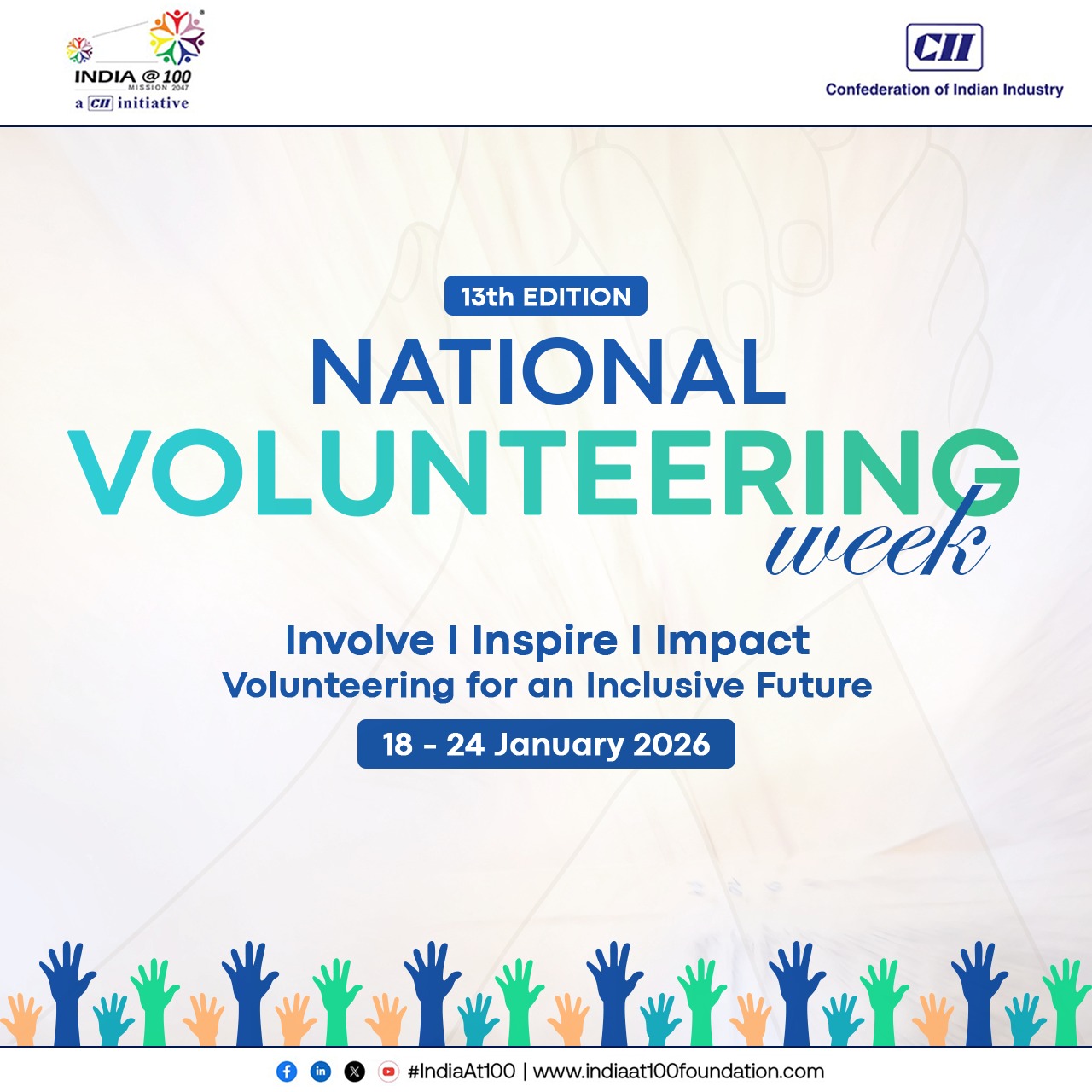
Every year, the India@100 Foundation, a CII initiative, champions volunteering by organising the National Volunteering Week. This gives citizens from all walks of life the opportunity to offer their time, skills, and empathy toward causes they believe in.
Through initiatives that advance education, sustainability, community well-being, and cultural engagement, we seek to foster collective action to create pathways for purposeful action and long-term change.
This January, we are back to reignite the spirit of service — and we
encourage individuals and organisations alike to register on the
National Volunteer Grid (NVG) and be part of this collective movement.
|
|
|
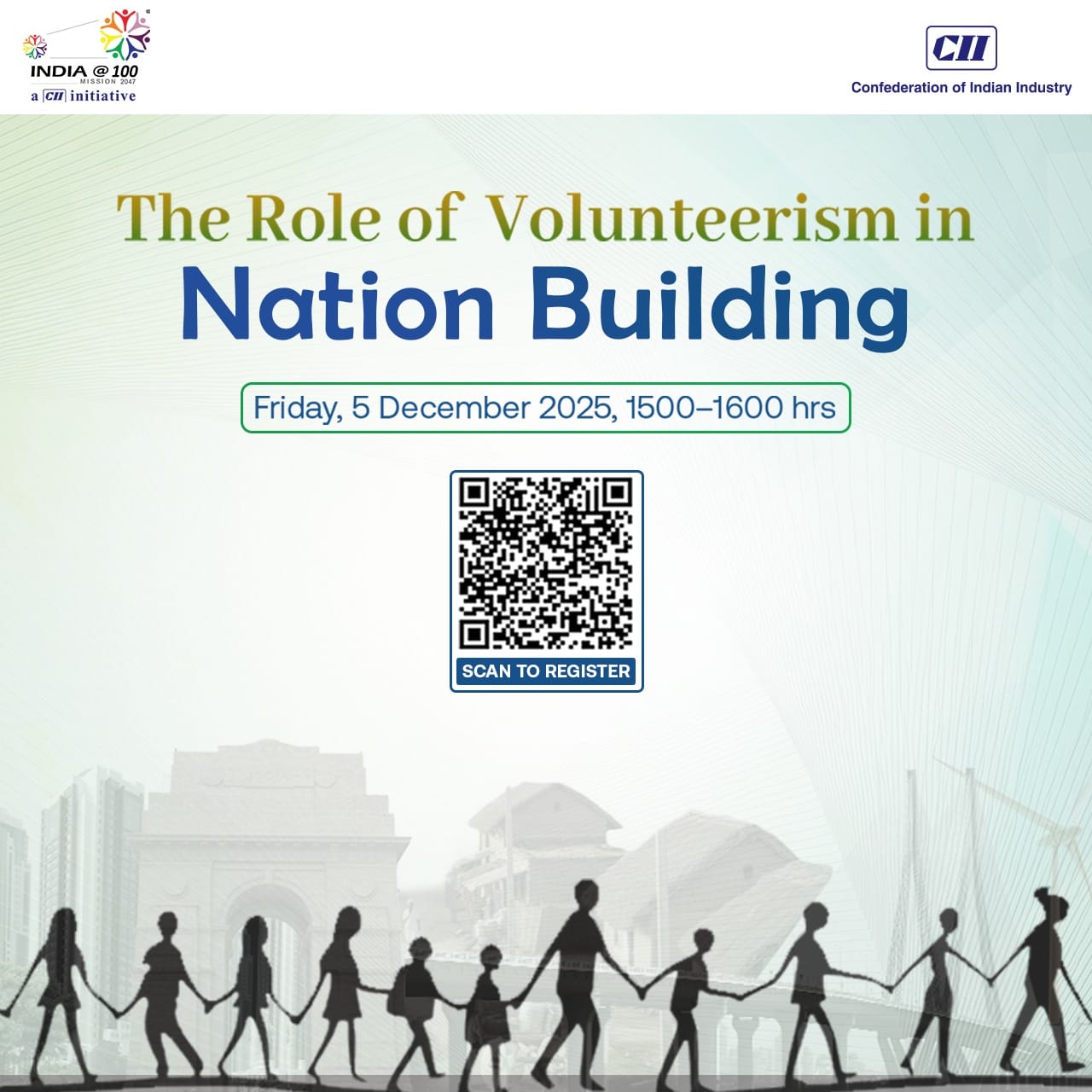
On the International Volunteer Day – Friday, 5 December 2025 – India@100 Foundation will hold a virtual discussion on “The Role of Volunteerism in Nation-Building”. The session will examine the strategic value of volunteerism and highlight how cross-sector collaboration can enable measurable, sustainable impact at scale. We invite you to join the conversation.
|
|
|
CHANGESPEAKE is a series of conversations featuring individuals who, through their beliefs and passion, are shaping the contours of an inclusively developed India@100. We hope the series will motivate others to emulate these best practices and also build their ability to open new frontiers for the country. Doing so will help accelerate change and build the momentum that India needs to reach its ambitious goals for 2047.
|
“If we want to work with people and not just for them, we have to move beyond numbers and start valuing the human side of change. Listening, empathy, and trust are the real indicators of impact.”
|
|
|
|
|
Anshu Gupta, a Ramon Magsaysay Awardee, is the Founder of Goonj and Gram Swabhimaan. Often called the “Clothing Man of India,” he has redefined the idea of giving by transforming surplus urban material into powerful tools for rural development. Through his pioneering initiatives, Anshu has inspired a nationwide movement rooted in dignity, empathy, and community-led change—making him one of India’s most respected voices in social innovation and inclusive development.
|
|
|
What sparked your journey from a small project aimed at helping marginalized communities to leading work acknowledged across the country?
The journey of Goonj began with a simple yet powerful observation that clothing, one of the most basic human needs, was missing from the development work or agenda. In 1999, Goonj started with the idea of valuing material that urban India was discarding. We looked at how this material could be turned into a resource for rural communities, not as charity, but as a tool to tackle material poverty. Over time, this idea expanded into a movement that focused on dignity, participation, and ownership.
Recalling one of my first experiences, in 1991, after a massive earthquake hit Uttarkashi belt of Uttarakhand (then U.P.), I met a man wearing a jacket made out of a jute bori (gunny bag) asking for woolens to survive. And in the same period meeting a family in Delhi which used to support local administration by picking up unclaimed dead bodies and understanding their struggle to survive in winters not because of cold but because of lack of clothing taught me how simple looking issues are actually big issues. As a keen photographer the images stayed with me. It showed the harsh reality of what people go through in their life and more importantly during disasters and how we often ignore something as fundamental as clothing in relief and development work and how we have never taken Material poverty as a serious development issue.
I didn’t come from the development sector, I didn’t know about what was possible, what wasn’t. The early realization that it was not just about doing some good work, may be it is journey of bringing some non-issues into the category of issues which matters for millions and where masses themselves can solve with a little nudge.
In urban areas, we encourage people to “Goonj it…” — to contribute mindfully, knowing their excess could be part of a larger circular system. In rural areas, we focused on enabling people to work on their own development priorities, whether building roads, cleaning ponds, or addressing local issues, while receiving material as a reward for their efforts and not as charity, as charity kills dignity of people and with challenged dignity , we cannot think of development This approach created community-driven development, built local assets, and generated fair and dignified employment.
Through this process, Goonj naturally connected with broader issues like climate action and social equity. The impact came from trusting people’s wisdom, valuing their participation, and ensuring their dignity throughout.
We also realised that both the demand and supply were very high and there were no other players doing this, so had to create all systems from scratch so got the first movers advantage in scaling it. Disasters played an important role in spreading the work. Entered areas for relief work, couldn’t ignore the long standing development challenges of the people in those vulnerable and devastated regions.
Over the years, Goonj grew through listening, learning, and constantly evolving with people, both with communities and the team. When we focus on dignity, trust, and inclusion, real change follows.
India is extremely diverse in terms of culture, language, infrastructure, climate — how adaptable have Goonj’s models been when working across, say, remote Himalayan areas vs densely populated plains or coastal regions?
India’s diversity presents a wide range of challenges and opportunities. Goonj’s approach has remained effective across these varied contexts because it is fundamentally community-led and flexible. Instead of applying a uniform model, we focus on understanding local needs, environments, and cultural contexts, allowing the work to evolve accordingly.
We have worked in remote Himalayan villages, flood-affected regions, arid zones, and coastal areas and more. In each case, the community identifies the issues it wants to address and takes the lead in solving them. Whether it is building a road, restoring a water body, or repairing local infrastructure, the solutions are shaped by the people who live there.
For example, in the hills of Jammu, we expected the community to prioritise road construction. Instead, they chose to create an Akhara, a levelled wrestling ground that held cultural significance for them. This outcome reflected the importance of listening to community voices rather than making assumptions.
Urban surplus material, when used thoughtfully, becomes a valuable resource in this process. It supports local efforts, encourages civic participation, and builds a sense of shared responsibility between urban and rural areas. Goonj’s model is adaptable because it is built on respect for local knowledge, decentralised decision-making, and a practical understanding of on-ground realities with our role as a catalyst, that mobilises, motivates and enables people..
Goonj’s model in the last 26+ years has been completely adaptive as the design of the work is completely place based, based on decisions of the communities we work with. Covid was biggest pivot and disruption to the model but we adapted fast and responded with double our capacity, showing resilience and innovation at scale. That’s also emerged as a harvard case study later.
What role do you see for technology, social media, digital platforms in amplifying community-led change, without losing the “grounded” nature of your work?
Technology and digital platforms have a vital role to play in amplifying community-led efforts when they are used as tools, not as replacements for real engagement. At Goonj, our work begins and stays rooted on the ground, with people and their realities. That cannot be replaced by digital convenience. Goonj’s work grew, innovated and scaled over the last two decades, with basic technology tools as it placed a lot of value on Human Intelligence in community led change ,over the last few years we are consistently but carefully curating tech inputs into our work, to complement human intelligence and efforts.
Technology helped in building transparency, scaling awareness, and connecting people across geographies. Social media, for instance, has helped us share stories from remote parts of the country, often bringing visibility to voices that are rarely heard. It also plays a strong role in mobilising urban participation, whether through campaigns, volunteering, or material contributions.
We understand that Tech can be a great enabler, when coupled with human intelligence. Also it can unlock a lot of efficiency and effectiveness of resources but one must also carefully examine who is left out or whose dignity is challenged, because of technology
Have two strong statements while integrating technology in our work.
A) by creating roti.com we can’t provide roti as what we need to complement, supplement is – Human and B) Yes AI is a growing tool but for sure not the only solution and not at the cost of HI (Human intelligence) and in our mission, also not at the cost of GRI (Grassroot Intelligence).
|
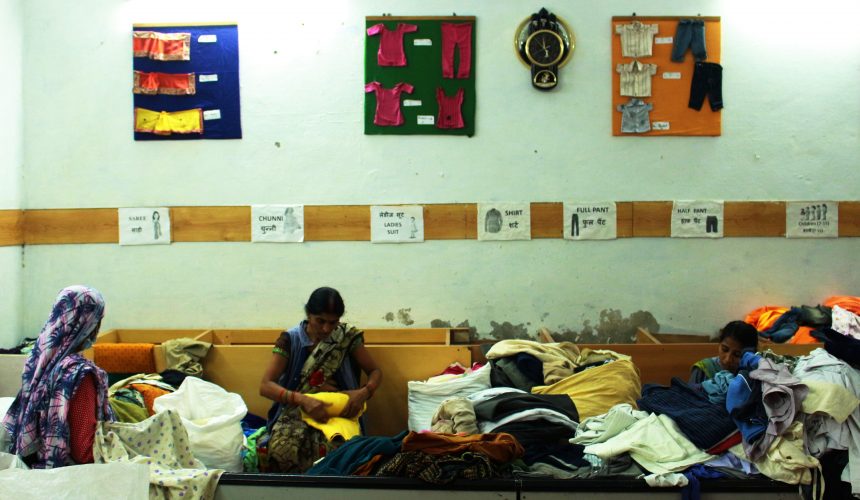
Women at Goonj sorting clothes received or repair and recycle.
|
What role do you see social enterprises and grassroots innovations playing in India’s journey to becoming a developed nation?
If India is to truly become a developed nation, we have to redefine what development means — not just in terms of GDP, but in how we include and empower the last person in the line. Social enterprises and grassroots innovations are central to this process because they respond to real needs with contextual, sustainable solutions.
Social enterprises bring together purpose and practicality. They look beyond profit and focus on long-term impact. Grassroots innovations, on the other hand, emerge from lived experiences — people solving their own problems with local resources and deep understanding of their environment.
What excites me is that these models challenge traditional top-down approaches. They are participatory, inclusive, and rooted in the idea of dignity. Whether it’s a small solution for clean drinking water or a model like Goonj’s that turns urban surplus into a resource for rural development, these efforts collectively strengthen the foundation of our country and present a model to the world.
India’s progress must come from within — from people solving their own problems, supported by ecosystems that value and scale their ideas. Social enterprises and grassroots innovations are not peripheral to development. They are essential to making it meaningful and lasting.
I feel SE’s and grassroots innovations are the social glue that builds and nurtures community.
Most importantly SE’s and grassroots innovations play the role of bees in a nation, cross pollinating ideas and connecting unconnected stakeholders and resources..
What message would you like to share with the next generation of changemakers — those who aspire to transform communities, create impact, and shape the nation’s future?
To create meaningful change, the first step is to listen and not to respond, but to truly understand. Empathy is not a soft skill in the social sector, it’s the foundation. Without a real connection with people, our efforts risk becoming mechanical or superficial.
In the development space, we often try to fit impact into categories or frameworks, measuring success through just the numbers or return on investment. But real change doesn’t always show up in data. How do you quantify the dignity, the shift in mindset, or the trust a community builds over time?
At Goonj, we’ve learned that the most powerful outcomes are often invisible, a sense of self-worth, local leadership, or communities coming together to solve their own issues. These are not things you can capture in a report or a graph, but they are the essence of sustainable development.
If we want to work with people and not just for them, we have to move beyond numbers and start valuing the human side of change. Listening, empathy, and trust are the real indicators of impact.
My simple message is that – Do it for the joy of doing something, not for applause, fame etc. that may come and go. Don’t center your work on you. Center it on people. That way the work will outlast you.
Be ready to break and build the mold of your thinking, assumptions, ideas, approaches again and again. Only be fixed on the values and non-negotiables of your personal and professional life. These will help you navigate all uncertainty and confusing times. Be the most watchful around your ego and stickiness to anything. Keep asking yourself questions.
There are two ways of working - one that you talk about the work and the second - the works talks about you. The second approach takes time but is much more fruitful and gives us a chance to make mistakes, learn and create strong pillars.
And by doing such work we are not doing a favour to anyone, it makes life meaningful, it brings a purpose, as in any case doing good is a collective responsibility.
And then the most important- Take care of yourself, your wellbeing. This is a long game, your life and wellbeing will be critical for many things including your dreams for yourself and your dreams for the nation.
|
|
|
|